Bachelor of Social Work (BSW)

This Course Structure is Curated as per the NEP-2020 Guidelines
Course Overview
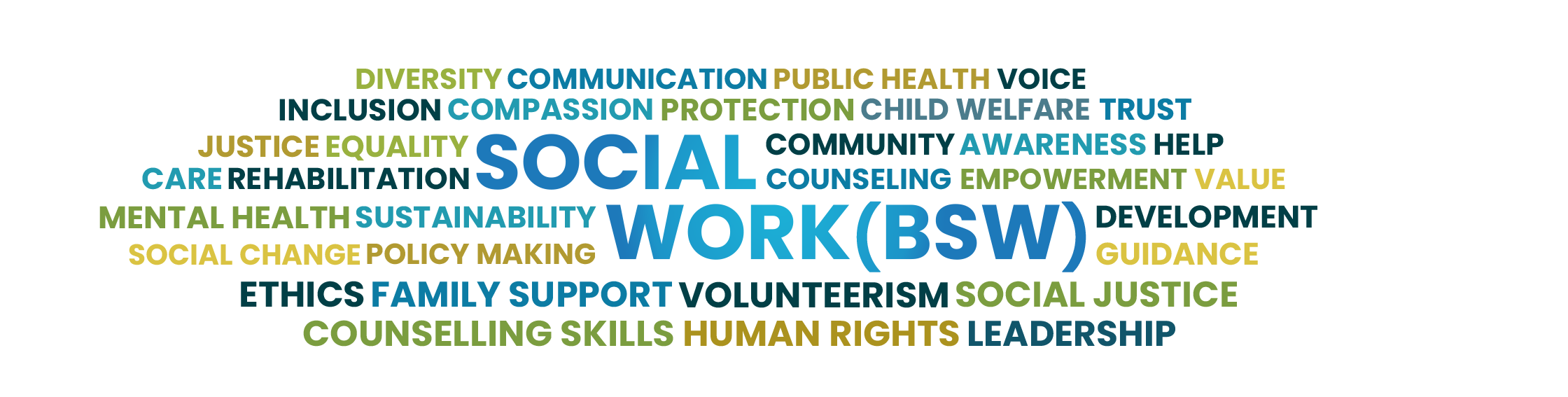
Bachelor of Social Work (BSW) program at Malla Reddy Vishwavidyapeeth, Hyderabad, is an undergraduate program designed to provide comprehensive education and hands-on field training in professional social work practice. This program focuses on equipping students with theoretical knowledge and hands-on skills from the 1st semester itself. The curriculum covers casework, group work, community organisation, social welfare administration, social policy, research methods, CSR & ESG compliance, project planning, and grant writing. Students gain practical experience through structured field placements with NGOs, hospitals, schools, panchayats, and government welfare departments. Graduates of this program emerge as ‘Skilled Social Work Professionals, Programme Officers, and CSR Executives’, enabling them to pursue further higher studies & do research in Social Work and Development Studies along with plenty of job opportunities globally.
Job Roles & Progression
| Duration | Role | Roles and Responsibilities | Salary Range |
| 0–2 Years | Programme Officer / CSR Associate / Field Coordinator | Implements field programmes at NGOs / hospitals / panchayats, manages community engagement, supports CSR project documentation (BRSR / GRI), and learns programme evaluation under senior mentors. | ₹2.5–5.0 LPA |
| 2–5 Years | Senior Programme Officer / CSR Executive / Hospital Social Worker | Owns programme delivery, leads CSR project execution at corporates, manages medical / psychiatric social work cases, and reports to UN / UNICEF / government bodies. | ₹5.0–10.0 LPA |
| 5–10 Years | Programme Manager / CSR Manager / Senior Hospital Social Worker | Manages multi-state programmes with crore-scale budgets, leads CSR strategy at major corporates, advises on government scheme implementation (NHM, ICDS, NRLM). | ₹10.0–22.0 LPA |
| 10+ Years | Country Director / Head of CSR / Foundation CEO | Heads NGO at national level, leads CSR / sustainability function at major corporates, runs philanthropy foundations, or consults internationally with UN / World Bank. | ₹22.0–60.0 LPA |

Course Details
Description: 4 Years Degree Program
No. of Seats: 40
No. of Credits: 160 minimum & as specified
- Eligibility
- Curriculum Structure
- Program Outcomes
- Career Enhancement
- Higher Studies
- Job Roles & Progression
The minimum eligibility for B.Sc. Diabetic Sciences is a pass in 10+2 with at least 50% marks in Physics, Chemistry and Biology from a recognized board (CBSE/ISC) or equivalent.
| Semester | Name of the Subject |
| Semester 1 | Human Anatomy Human Physiology Biochemistry Basic Principles of Nutrition Introduction to Diabetes Practical: Anatomy and Biochemistry Lab |
| Semester 2 | Pathophysiology of Diabetes Pharmacology Fundamentals of Diabetes Management Community Medicine and Public Health Practical: Diabetes Management and Patient Interaction |
| Semester 3 | Advanced Diabetes Management Endocrinology Diabetes Complications Clinical Psychology Practical: Monitoring and Managing Diabetic Patients |
| Semester 4 | Diabetes in Special Populations (Pediatric and Geriatric) Dietary Management in Diabetes Diabetes and Cardiovascular Diseases Research Methodology and Biostatistics Practical: Specialized Diabetes Care |
| Semester 5 | Gestational Diabetes Management Lifestyle Modification and Diabetes Diabetes in Critical Care Settings Diabetes Foot Care Practical: Foot Assessment and Lifestyle Counseling |
| Semester 6 | Advanced Therapeutics in Diabetes Insulin Pump Therapy Emerging Trends in Diabetic Technology Health Education and Promotion Practical: Insulin Pump Programming and Patient Training |
| Semester 7 | Clinical Internship in Diabetology Case Studies and Patient Management Practical: Diabetes Clinics and Hospitals |
| Semester 8 | Diabetes Unit Management Thesis/Research Project Entrepreneurship in Diabetes Care Practical: Clinical and Administrative Operations |
- Clinical Management of Diabetes: Proficiency in diagnosing, monitoring, and managing patients with diabetes and its complications.
- Dietary and Lifestyle Counseling: Skills in advising patients on diet, exercise, and lifestyle modifications to manage diabetes effectively.
- Diabetes Technology and Insulin Management: Knowledge of insulin pumps, glucometers, and emerging technologies in diabetic care.
- Patient Education and Public Health: Expertise in educating patients and communities on diabetes prevention and management.
- Specialized Diabetes Care: Focus on managing gestational diabetes, pediatric diabetes, and diabetes in elderly populations.
- Diabetes Unit Management: Skills to manage diabetes care units, including administrative tasks, compliance, and patient coordination.
- Certification in Advanced Diabetes Management: Training in advanced clinical care and therapeutic interventions for diabetic patients.
- Lifestyle and Dietary Management Certification: Focuses on dietary planning and lifestyle interventions for managing diabetes.
- Diabetes Technology Certification: Covers the use of modern diabetic technologies such as insulin pumps and continuous glucose monitors.
- Public Health and Patient Education Certification: Emphasizes community-level education and diabetes prevention programs.
- Diabetes Unit Management Certification: Provides training in managing diabetes clinics and administrative operations.
- M.Sc. in Diabetes or Endocrinology
- Postgraduate Diploma in Diabetology
- Master’s in Clinical Nutrition
- Advanced Certifications in Diabetes Technology or Public Health
| Duration | Roles and Responsibilities | Salary Range |
| 0-3 years | Diabetes Educator, Clinical Nutritionist | ₹4,50,000 – ₹6,50,000 per annum |
| 3-5 years | Diabetes Specialist, Lifestyle Coach | ₹6,50,000 – ₹8,50,000 per annum |
| 5-10 years | Senior Diabetes Care Specialist, Unit Manager | ₹8,50,000 – ₹12,00,000 per annum |
| 10+ years | Director of Diabetes Care Services, Consultant Diabetologist | ₹12,00,000+ per annum |
Note: Salaries vary based on experience, location, and type of healthcare institution.
A pass in 10+2 (Higher Secondary) in any stream with a minimum aggregate of 50% or equivalent CGPA from a recognized board (CBSE/ISC) or equivalent.
BSW students undergo hands-on training in casework simulation rooms, group work labs, social statistics labs, counselling skills studios, and structured field placements at hospitals, NGOs, schools, panchayats, and government welfare offices.
- Professional Social Work Skills: Mastery of casework, group work, and community organisation methods.
- Field Practice Competency: Verified hours of supervised field work across diverse social settings.
- Research & Statistics: Hands-on capability with SPSS, R, and qualitative research methods.
- CSR & ESG Knowledge: Understanding of corporate social responsibility, BRSR, and GRI reporting.
- Programme & Project Skills: Skills in log-frame analysis, theory of change, and grant writing.
- Government Scheme Familiarity: Knowledge of NHM, ICDS, NRLM, and other major welfare schemes.
- Certification in CSR & ESG Reporting (BRSR / GRI): Specialised credential for corporate social responsibility roles.
- Certification in Counselling Skills: Foundational counselling credential.
- Certification in Project Management for Development (PMP / PMD Pro): Industry-recognised project management credential.
- Certification in Grant Writing & Donor Engagement: Specialised credential for resource mobilisation.
- Government Scheme Implementation Certification (NHM / ICDS / NRLM): Public-sector welfare credential.
- Master of Social Work (MSW)
- M.A. in Development Studies / Public Policy
- MBA in Social Entrepreneurship / Rural Management
- Postgraduate Diploma in CSR / ESG Management
- PhD. in Social Work / Development Studies
- Candidates must have passed 10+2 or an equivalent examination in any Stream from a recognized Board (CBSE, State Intermediate Board, NIOS, or Equivalent), securing a minimum aggregate of 60% marks in the first attempt.
- Candidates who have Qualified in any of the NEET, CUET (UG), TG EAPCET, MRVCET or any other Equivalent National/State-level entrance UG Examination, will only be considered for admission.
- Academic Gap: For the 2026–27 academic year, candidates from the previous two academic years, 2024–25 and 2025–26, may be considered. Admission shall not be granted to applicants with an academic gap of more than two years, unless otherwise permitted under applicable UGC norms.
BSW students undergo hands-on training in casework simulation rooms, group work labs, social statistics labs, counselling skills studios, and structured field placements at hospitals, NGOs, schools, panchayats, and government welfare offices.
- Professional Social Work Skills: Mastery of casework, group work, and community organisation methods.
- Field Practice Competency: Verified hours of supervised field work across diverse social settings.
- Research & Statistics: Hands-on capability with SPSS, R, and qualitative research methods.
- CSR & ESG Knowledge: Understanding of corporate social responsibility, BRSR, and GRI reporting.
- Programme & Project Skills: Skills in log-frame analysis, theory of change, and grant writing.
- Government Scheme Familiarity: Knowledge of NHM, ICDS, NRLM, and other major welfare schemes.
- Certification in CSR & ESG Reporting (BRSR / GRI): Specialised credential for corporate social responsibility roles.
- Certification in Counselling Skills: Foundational counselling credential.
- Certification in Project Management for Development (PMP / PMD Pro): Industry-recognised project management credential.
- Certification in Grant Writing & Donor Engagement: Specialised credential for resource mobilisation.
- Government Scheme Implementation Certification (NHM / ICDS / NRLM): Public-sector welfare credential.
- Master of Social Work (MSW)
- M.A. in Development Studies / Public Policy
- MBA in Social Entrepreneurship / Rural Management
- Postgraduate Diploma in CSR / ESG Management
- PhD. in Social Work / Development Studies

Fee Structure Per Academic Year
| Tuition Fee | Miscellaneous Fee | Scholarship (Applicable for Tuition Fees of 1st year only) | ||||
| 90,000 ₹ | 15,000 ₹ | >95% (Full Tution Fee) – 90,000 ₹ | >85% to 94.99% (50%Scholarship) – 45,000 ₹ | >80% to 84.99% (25%Scholarship) – 22,500 ₹ | >75% to 79.99% (10%Scholarship) – 9,000 ₹ | >70% to 74.99% (5%Scholarship) – 4,500 ₹ |
| Tuition Fee | Miscellaneous Fee | Scholarship for % of Marks | ||||
| 90,000₹ | 15,000 ₹ | >95% – 20,000 ₹ | >85% to 94.99% – 15,000 ₹ | >80% to 84.99% – 10,000 ₹ | >75% to 79.99% – 7,500 ₹ | >70% to 74.99% – 5,000 ₹ |
*Note : From 2nd Year onwards, scholarship shall be given only if the candidate secures 60% aggregate in the first attempt.